
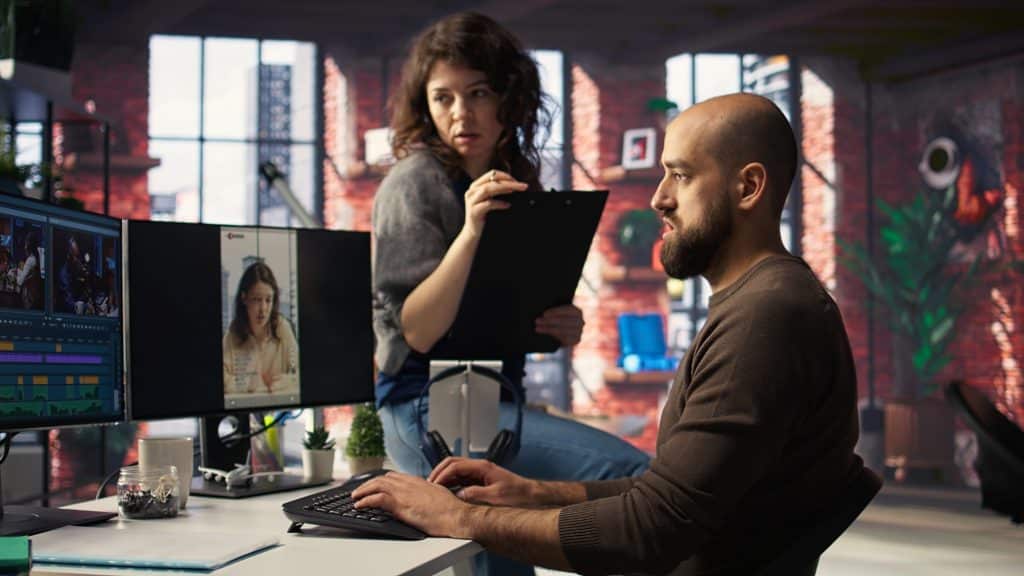
AI could make filmmaking faster, easier and cheaper. But many fear it will also threaten jobs and take the soul out of a celebrated artform.
Words:
- Artificial intelligence (AI) is computer technology that imitates human intelligence. It learns, can make decisions, and produce texts, images or video based on all sorts of data.
- The benefits of something are the positive sides of it.
- Industry insiders are people who know a lot about the field (e.g. film) a they work in. When workers stop working or protest to get better conditions, this is called industrial action.
- Something or someone that is acclaimed is very good and respected my many people.
- The controls of a machine are its buttons or settings. They help you control the machine.
- Something that’s at a consumer level is made for normal people to use, not only experts.
- Your ethnicity is the group of people you belong to, who you share the same culture, skin colour, language or history.
- A bias is a way of thinking that makes you prefer one thing, person, or group more than another. This is often unfair. If an AI-system has built-in biases, it means it bases its actions on biased information.
- Tweaking means making small changes to make something better.
- A hybrid model mixes two different ways of working, e.g. a car that runs on both gasoline and an electric battery.
- The gold standard is the best example that others try to match.
Video:
Warming up
1. You’re about to watch a video about the use of AI in Hollywood movies. Have you seen videos made with AI online, and can you tell if they were made with AI? Explain what you look for to tell if something is made with AI.
2. The video discusses what professionals in the film industry think about AI. Which jobs in the film industry do you think might be affected by AI?
Questions about the video
Watch the video from 0:00-2:30.
3. The presenter says that film professionals have protested against the use of AI in films. Why is that?
4. Benjamin Barfoot had trouble making the short AI video for the BBC. What was the main cause of his problems?
A: The AI could generate video, and but could not generate matching audio.
B: He was too ambitious and was trying to do too much.
C: The AI software can only understand very simple prompts.
D: The only controls the software has are prompts, so he can’t tweak anything.
Watch the video from 02:30 to the end.
5. Benjamin Barfoot says the AI software is very random. Based on his explanation, what kind of controls do you think he would prefer?
6. According to Benjamin Barfoot, why does the presenter Mark look different in the AI video? The video mentions two reasons. Select the correct ones.
A: Because the AI is not good at recognising faces.
B: Because the software takes the footage of Mark apart, and rebuilds him again.
C: Because the AI is trained using footage of mostly white people, so Mark’s ethnicity looks different.
D: Because the AI takes out all imperfections.
E: Because the AI is based on Hollywood movies, so they make Mark look more like a Hollywood actor.
7. What did Barfoot like about working with a human crew while making his own film?
Task
Option 1: Imagine you wanted to make a short film. Think of one scene that could be in this film. What do you want this scene to look like?
Write a prompt that an AI software could use to make this scene. You can use online sources for help on writing a good prompt.
Option 2: What arguments can you think of against the use of AI?
Write a short email to the CEO of a film production company, outlining your thoughts about AI in film. Convince the CEO that it’s a bad idea to use AI. You can use online sources to find more information about the downsides of AI in film.
Van de makers van All Right!, Of Course! en Taalblokken Engels
Antwoorden bekijken
Om de antwoorden te kunnen zien, moet je zijn ingelogd. Heb je nog geen account? Meld je dan nu aan! Het is GRATIS.